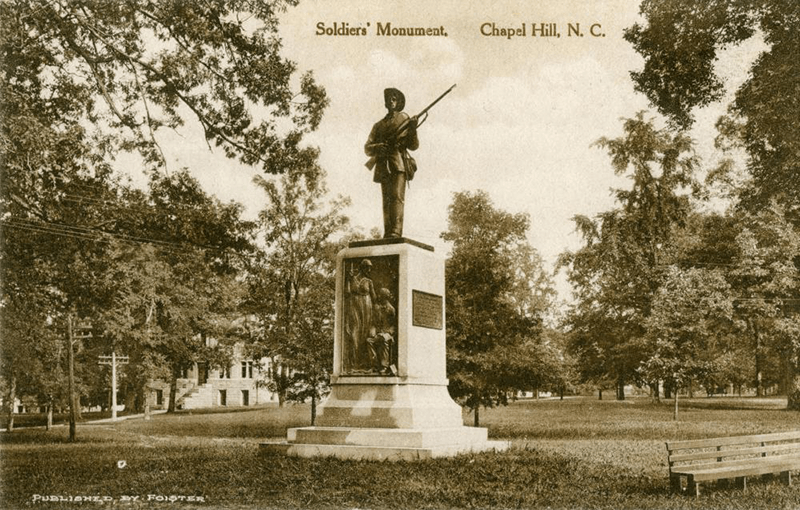
Photo Source: A Place for Chapel Hill’s Silent Sam
I spent the 2020 lockdown teaching remotely at the State University of New York (SUNY). During this period, I explored the impact of historic forms of oppression from a regional perspective. Witnessing national policies and the normalized hate speech targeting BIPOC, LGBTQIA+ individuals, and immigrants influenced my second project — a comparative analysis of two historic Southern universities. From 2021 to 2022, I conducted studies at the University of North Carolina at Chapel Hill and the University of Georgia. By conducting multiple focus groups and collecting over 2,800 survey responses, I learned about the contemporary student experience.

While my initial research examined how Eurocentric values were transmitted through design choices, this study focused on how students developed a sense of belonging, well-being, and community at these campuses through contact with nature and historic campus design. The built and natural environments of flagship southern public universities remain connected to the Northern institutions via their lineage of white supremacy. I aimed to capture how marginalized groups experienced the pandemic, education, and social movements on their campus in the shadows of Confederate statues. My manuscript, “Green Space as a Foundation for Student Wellbeing in Higher Education,” published by Routledge in June 2025, served as the basis for my next project on the experience of green space at SUNY Old Westbury, a state university in New York.
My article, “Understanding Student Experience of Campus Green Space Post COVID-19,” was published in the Journal of American College Health. This suburban university, with its expansive landscape, served as an interesting case study of the LGBTQIA+ and BIPOC experiences at a predominantly white institution.
Several focus groups and 366 survey responses revealed how students experienced returning to campus after the lockdown and the role of nature in relieving stress.
At this campus, there was a noticeable racial dimension to how students navigated the environment; therefore, feedback from non-white participants offered unique insights into the relationship between engagement with green space and marginalized identities. In “Intersectional Identities, Inequality, and Public Green Space“, I translate my scholarship into a policy proposal on inclusive planning practices.
This work inspired my current project, which explores shared outdoor spaces and unleashed dogs in Massachusetts. I established relationships with several outdoor recreation groups across the state and with online neighborhood communities to assess experiences at public parks and wooded areas. In this study, I draw on over 1,000 survey responses from both dog owners and non-dog owners, as well as 20 in-depth interviews, to better understand the gendered and racialized experiences involved.
 Vanita Naidoo