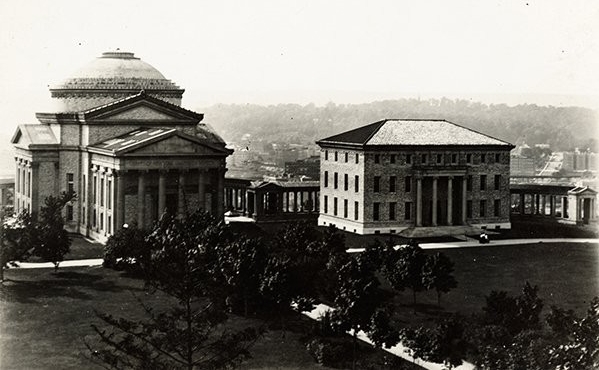
Photo Source: NYU’s former University Heights Campus in the Bronx
My early scholarship mainly focused on the connection between identity and access to nature. As physical symbols, they demonstrate how white hierarchies are reflected in spaces and can harm those who challenge these structures, such as BIPOC and LGBTQIA+ communities. A remnant of former empires, the campus embodies colonial memory through its design choices. By examining the historical roots of the American higher education system, my research showed how white spatial imaginaries influence the built and natural environments in campus design and how these impact student mentalities.
Examining restorative experiences, I further challenge existing structures. At the CUNY Graduate Center, we were encouraged to dismantle white supremacy by exposing it and prioritizing the empowerment of marginalized identities. Nature is a third space where restorative justice takes place; therefore, my book, “Campus Design and the Community College Experience: An Exploration of Stress, Belonging, and Identity,” explores socio-spatial relationships, nature, and race.
Published by Routledge in 2022, this qualitative research was conducted in the Bronx, New York.

After a decade of teaching at community colleges in New York, this project focused on historically marginalized identities and restorative practices. Drawing on my experiences in South Africa and the United States, I explore how colonialism and segregation have racialized the use and perception of shared outdoor spaces. Kimberlé Crenshaw, W.E.B. Du Bois, and Paolo Freire have shaped my understanding of whiteness and privilege. As a result, my scholarship reveals how natural environments sustain historic forms of oppression that marginalize queer and BIPOC communities.
Book review: Community College Review
 Vanita Naidoo